Literature, reviews, photography, and occasional oddities.
Here's all the posts under Fiction!
Showing posts with label Fiction. Show all posts

Monday, January 02, 2017

Book Review: The Quick by Lauren Owen

The Quick was referred to me by Penguin Random House Hotline (Thank you, Bridget! So umm... what do I need to do to get your job, pretty please?) Uhm, anyhow... to be honest, I had absolutely NO EXPECTATION for this book. Usually I read reviews on Goodreads to get a feel for what to expect before starting a book, but this time around, I went in totally blind! And am sure glad I did because apparently, from the reviews I read after I had finished reading this book, I could tell that people somehow had the wrong sort of expectation out of this book. So, diving in blind was definitely the right choice.

As for The Quick, it's an adult fantasy book. It is about people who are, one way or another, dealing with vampires. "Quick" is a term used by vampires of this book, set in the victorian era England, for mortal humans. A fitting title if you consider the story. It really is about the mortals, and not necessarily about the vampires themselves. They simply shape the story of these "Quicks" that surround them; more accessories and less the subjects. I thought that was so smart! In many ways this book made me think of Interview with the Vampire, albeit the difference in subject matter (IwtV really was about the vampires themselves).

Sunday, November 20, 2016

The People in the Trees by Hanya Yanagihara

The People in the Trees by Hanya Yanagihara tells the story of Norton Perina, a Nobel Prize winning scientist, who practically chanced upon the discovery of a lifetime while on an anthropological expedition in 1950. The book is written in the form of an autobiography from Norton Perina to his friend and colleague Ronald Kubodera.

Before I start, I should warn the reader that this book is in many ways extremely unconventional and pushes the boundaries of a lot of controversial things in several isolated instances. This book is, in many ways, a lot like Lolita in which the reader is pushed to the extremes. May be even pushed over! Depends on the reader of course. Truth be told, I loved The People in the Trees even more than I liked Lolita. I love a controversial book, and this one felt like it was testing me and my limits in practically every other turn of a page.

A little on how I came across this book before I delve into the plot and the characters: earlier this year I noticed a lot of hype about a book called A Little Life by the same author. I wanted to check out the book, but unfortunately, both the university library as well as the public library had a long hold list. The People in the Trees however was available, and I decided to give it a go as I had never read anything by Hanya Yanagihara before. And I must say, if you asked me to name my top 3 contemporary authors, she would now be one of them.

Sunday, November 13, 2016

We Eat Our Own by Kea Wilson

I just finished reading Kea Wilson's debut novel We Eat Our Own. My thoughts? Hmm... let's go over what transpired from the beginning. I started reading the book and was sucked in from the very first page. The narrative was not something I was familiar with, and that alone was enough to spark my curiosity. Needless to say, Kea Wilson has a very weird way of writing... weird not in a bad way, quite the opposite actually. She has a unique style with her writing and her prose, which I found refreshing. And yet, on GoodReads, I gave a rating of 3-stars. Why? Because of the following:

Around three quarters into the book, I started to wonder when we will get to the climax. There was going to be a climax, that I was sure of. So I kept waiting. And Reading. I thought I knew exactly what the climax was going to be, but I didn't know how it was going to play out (more on this reference later in this review), so I was starting to get impatient. And then, when there was about 20 pages or so left in the book, something happened! And it was NOT the climax I was expecting...

Thursday, September 22, 2016

The Goddess Chronicle by Natsuo Kirino

After reading Out and Real World, it is safe to say that Natsuo Kirino is currently one of my favorite authors of feminist noir fiction. She is not afraid to show the dirty and ugly sides of the female of the species, nor the weaker sides. A lot of the times I feel like real issues get overlooked, sometimes intentionally, in the name of feminism. We want to show that women do not have to be weak and live under the shadows of men. True, we do not. But it doesn’t help to sugarcoat things and completely disregard the fact that we are in fact, very different from the male of the species, both physically and emotionally. In my opinion, disregarding the unpleasantries only adds to the problem, not the other way round.

Natsuo Kirino’s protagonists, all women in the three books that I have read so far, are strong. Very much so. But they have weaknesses like real women do. They have limitations as to how much they can do or how far they can go within the socio-economic boundaries that are, sometimes unfairly, set upon us by the society that we live in. Natsuo Kirino is from Japan, so her work of course reflects the Japanese society and issues that are more pertinent to that culture than, say, the western one that we live in. But even so, as women, I think a lot of us can relate to certain characteristics that Ms. Kirino portrays in her characters.

Thursday, September 15, 2016

Real World by Natsuo Kirino

A week ago I finished reading Out by Natsuo Kirino, my first book by the author. As soon as I finished, I checked out the only other Natsuo Kirino book available in my library — Real World (translated from Japanese by Philip Gabriel). Somehow, Real World turned out to outlive my expectations, and as crazy as it sounds, proved to be even better than Out! One uncanny similarity in these two books is that, they are both focused on a group of four girls. Well, in Out, they were more women than girls, considering the characters were in their 30s, 40s and 50s. In Real World, the girls are high school seniors. The story and the plot, as well as the characters are significantly different however. Somehow, even though the four girls in Real World are much younger, I felt like their characters had more depth than the characters in Out. I do not do star reviews anymore, however, if I had to, I’d give Out a 4.7 out of 5, and Real World… can I give it a 7.5 out of 5? Well, that’s just how much I liked this book.

Thursday, September 08, 2016

Out by Natsuo Kirino

I am smitten with Japanese literature in translation. I mean, why else would I spend hours every week just admiring the stacks of Japanese novels in the library? I have also found some Goodreads reviewers who happen to read a ton of Japanese novels and whose reviews I have come to trust. And so, as I’m sure you can imagine, thanks to them, my TBR pile has been soaring lately, and the bulk of it happens to be works of Japanese authors.

Anyhow, setting aside my obsession for the time being, let’s now talk about the book I finished reading last week-ish. Out by Natsuo Kirino, translated from Japanese by Stephen Snyder, is the latest addition to my favorite crime/thriller, contemporary fictions. I love a bad-ass, not so innocent, female protagonist, and Masako Katori is just that. She is smart, she appears to be just a normal, average, flawed being, unhappily married with a troubled, teenage boy at home, works a mindless job, and even at the age of 43, she has yet to fully figure herself out. Despite the choices she made and the things she’d done, I couldn’t help liking her. She has a strange charm about her, and Natsuo Kirino did a wonderful job of bringing out her charm. It’s like, I could totally see why everyone around her either depended on her or trusted her, or simple fell in love with her.

Saturday, August 27, 2016

NP by Banana Yoshimoto

Since this is Women in Translation month and all, I figured I’d honor it by reading Banana Yoshimoto’s (translated from Japanese by Ann Sherif) NP. Umm, no scratch that, that was a complete lie. I just felt like saying it … anyhow, yesterday I was browsing through the Japanese Literature section in my library, admiring row upon rows of original Japanese texts as well as translated books, as I often do, when I came upon a smaller stack of Banana Yoshimoto books. I remember reading an interview of Haruki Murakami, one of my favorite authors, on the Paris Review, where he mentioned enjoying Ms. Yoshimoto’s books. I haven’t really had time to give her a try, but yesterday, as I chanced upon her books, it felt like fate. I chose N.P. purely based on its small size. It’s a short novella at less than 200 pages, and the book itself is pretty small in size, so I figured I’d be able to finish it in a jiffy. Which I did! Took me just a couple of hours to get through the entire book… and I have to say, it wasn’t solely because of it’s size, but also because I got hooked from the get go!

Thursday, August 25, 2016

Eileen by Ottessa Moshfegh

The Man Booker Prize 2016 longlist was announced almost a month ago, and I finally managed to read ONE book out of the entire list. The reason I chose Eileen by Ottessa Moshfegh is because, one of my favorite reviewers — Clare of A Little Blog of Books — happened to describe Eileen as one of the creepiest books she had read this year. I love creepy, so I figured I’d start the list with this book.

Eileen is about a girl and her grand escape from her hometown where she was born and raised and spent most of her youth, being unhappy and neglected by her parents, always thinking less of herself, concocting up vivid imaginary situations that would make her feel important. She grew up in a dysfunctional family, and as almost always with the kids of such families, Eileen grew up a little off. Different from her peers in many ways that you wouldn’t know just by looking. The first person to see that she was a bit “different” just happened to be this eccentric young woman, who has issues of her own. May be it is because of that very reason, that Rebecca, the new (I already forgot what her post had been at the juvenile detention center that Eileen worked at, but if memory serves, she had been some sort of…) educational guidance counselor to the young prisoners, sought to take Eileen into her confidence. Eileen, on the other hand, was so distracted and, in search of a more appropriate word, enamored by her, who is the complete opposite of Eileen that she was ready to do anything to feel important, find a friend, akin to a lover almost, in Rebecca.

Monday, August 22, 2016

Lolita by Vladimir Nabokov

That’s right. I finally finished reading Lolita by Vladimir Nabokov. I have always wanted to, but somehow never managed to pick it up. Last week or so, in the middle of reading Eileen by Ottessa Moshfegh, I happened to feel a reading slump coming. I put down Eileen right away (temporarily), and while trying to decide which book to pick out of my TBR pile, one way or another, I completely ditched the pile and decided to give Lolita a go. It probably has to do with a book review by one of my trusted readers/reviewers –Clare of A Little Blog of Books. You see, she wrote a review of The People in the Trees by Hanya Yanagihara and happened to mention Lolita in there… so I checked out both books from the library, and started reading Lolita. The subtleties (or the mysteries) of life, eh?!

Well now, where do I even start? Lolita is a very disturbing book and from the very beginning, throws the sane and perhaps moderate reader into a chaotic mind — the mind of Humbert Humbert, our narrator of the day! Reading his narration is like listening to a madman who thinks he is perfectly sane. Which is not too far fetched in the case of Mr. Humbert. He is an unreliable narrator as unreliable narrators go. His relationship with Lolita was so one sided that at times I had to close the book, sit back and ponder what must really have been happening with this story. At times he made me mad, other times I did not know if I should feel sorry for him. Well, don’t judge me. I do not mean to lessen his crimes by saying I feel sorry for him. What he’d done is unforgivable, a criminal act or acts if you will, yes, and at the same time, may be the unstable and sick side of him made me somewhat sympathetic towards him.

Saturday, July 30, 2016

The Vegetarian by Han Kang: A Review of a Re-read

I read The Vegetarian by Han Kang (Translated from Korean by Deborah Smith) for the first time earlier this year, way before it won the 2016 Man Booker International Prize, and I read it right after I finished Kafka on the Shore by Haruki Murakami. And so, unfortunately, I read it ALL WRONG!

You see, Kafka on the Shore left quite an impression on me. Among all of Murakami’s books that I have read, this one left THE strongest impression and the after effects were quite severe. So, all along I was reading The Vegetarian while KotS was still weighing on my mind, refusing to let go at all. Needless to say, it wasn’t the right time to read a book that needed attention to details. I sped through The Vegetarian, reading the words, but barely retaining any meaning whatsoever. As you can imagine, the impression was not good. And I am ashamed to say, it wasn’t the book’s fault, rather mine from the beginning. I read the book all wrong at the wrong time. Ever since it won the Man Booker International Prize this year, I kept wondering whether I should give it a re-read. Also, one of my favorite and trusted book bloggers, Clare, at A Little Blog of Books had praised The Vegetarian a lot, so I was intrigued, and finally, couple of weeks ago, I decided to give this book another go.

Sunday, June 19, 2016

The Woman in the Dunes by Kobo Abe

Inside a scorching, suffocating hole in the sand dunes by the sea, there is the man, a school teacher and an insect collector, and the woman -- the woman who is his captor, as well as his companion, and at the same time his one and only ally. Truth be told, for me at least, the title would have been better suited if it were something like "The Man in the Dunes", or "The Captive in the Dunes", as the story seemed more about the man than about the woman. Regardless, this book had my attention from the very beginning. The starting was quizzical and had me wondering what was about to come next.

The man, mostly referred to as "the man" in the entire book, except perhaps a couple of times by his real name, gets caught by a pack of villagers living in these sand dunes and is made to live with a single woman whose work seems to be collecting sand every night. The purpose is for him to work alongside her and may be, in time, get together with her. Read "sleep together, have babies, make a family, etc." From the beginning the whole sham seemed a little too absurd, and it seemed like the man himself thought so as well. But as unreal as it may have seemed, with time, the villagers proved that they meant business. First of all, the house he was a captive at, like all the other houses in the village, was at the bottom of a pit surrounded by sand. The only way up was by a rope ladder which the villagers took away as soon as he was lured inside, like an insect.

Monday, June 06, 2016

A Wild Sheep Chase by Haruki Murakami

Not too long ago I picked up Wind / Pinball by Haruki Murakami, but left unfinished. I guess I wasn't quite in the mood (I'm going to have to pick it up again soon seeing how Wind / Pinball are the preceding stories of A Wild Sheep Chase). And then about two days ago I decided to give this one a go and I was hooked right away! I suppose, I was in the mood this time.

Mood is of extreme importance when reading Haruki Murakami novels. Well, I might say that mood is important no matter what you are reading, be that a Haruki Murakami book or an RF Microelectronics book by Behzad Rezavi... in any case... this time the mood hit me and I cruised through this book. What did I think of it, you ask? Well, It was a good book. I particularly liked the main character (who is also part of Wind / Pinball I assume, but since I haven't read those two stories yet, I have no way knowing if this is indeed the same character). Anyhow, this guy was totally my type, and for the majority of the book, I enjoyed reading it so much because I liked this character. The rest of it... the rest of the characters and the story were fairly simple, and uninteresting. It was entertaining, don't get me wrong, but not at a level I have come to expect from Haruki Murakami. Most likely because A Wild Sheep Chase is the very first novel that Murakami wrote. Wind and Pinball are more like short stories, or novellas, rather than novels, so that makes sense.

That said, it did have a very typical Murakami vibe going on, albeit a much watered down version of Murakami. There was a cat, there was something... or someone, that wasn't exactly a living, breathing human being, there was a mysterious girl, and the main dude was quite charming! And then there was a sheep too! A talking sheep this time... although it appeared he did most of the talking in dreams.

Monday, May 16, 2016

The Face of Another by Kobo Abe

The struggles of a scientist who has lost his face to a laboratory experiment gone awry, is the theme of this book. The narrator, a successful scientist, was the victim of an explosion caused by liquid oxygen, and as a result his face was now full of keloid scars. A horrendous face that he is too ashamed to show in public, and it is most likely for the better anyway, because the horrible sight would make people simply too uncomfortable.

He settled with bandaging his face every single day so as not to show the scars beneath. But a face covered in bandage is still not a pleasant sight, after all, and the people around him reacted to it accordingly. Which made him feel alienated, if not worse.

The entire book is in the form of a diary (or three, rather) where the narrator walks the reader through his state of mind during the process where he devises a plan to create a lifelike mask in order to open a roadway between himself and the outside world who pretty much shunned him because of the terrible state of his outer appearance, in this case, a bandaged face, or a lack of face thereof.

Initially at least, that's what it was. A simple ploy to get out of this uncomfortable situation that his scarred face has put him into. But eventually, as the reader keeps reading, we see the narrator's own state of mind being changed. In the beginning it was him and the others. But as time passed, it became him and his wife. Basically, he was trying to make things right with his wife. The wife in question was obviously having trouble coping with his changed form, and so, the narrator, in a state of desperation, wanted to create a new face, or a mask, that will make his wife feel comfortable around him.

Monday, May 09, 2016

Coin Locker Babies by Ryu Murakami

After finishing In The Miso Soup by Ryu Murakami (and liking it quite a bit), I wasn't sure what to expect from Coin Locker Babies. I suppose I expected something similar-- blood and gore, lots of creep, and psychologically repulsive yet engaging-- a book and the characters within that you hate to love, but do so anyway. Well, let's just say that this book surprised me. Did I love it? YES! Did it have a ton of blood and gore? YES! Was it creepy? At times, YES! And yet, the journey, the experience of going through the almost 400-page book, was nothing like that of In the Miso Soup. Coin Locker Babies had something in it that was absent all throughout the other book. The reality! As sad and unconnected from our everyday lives as the story had been, it was still real. OK, may be not all of it; there were surrealistic, isolated incidences throughout the book; but the people, the characters, were all, in one way or another, just so very humane.

Coin Locker Babies is about two boys, Kiku and Hashi. Boys who, by some tragic twist of fate, came to share very similar fates. They were both left, abandoned, in coin lockers by their respective mothers. They survived somehow, and were brought up in an orphanage, and later were adopted together by their foster parents. Friends as well as brothers, insanely protective of one another, these two boys grew up in a small island in Japan, seemingly normally, and yet forever haunted by their shared past of being abandoned in coin lockers. The book about these teenagers isn't really one of growing up... more like, growing up weird. While Kiku is a lone wolf, but well liked by his peers, Hashi is seemingly more socially adaptable, while hiding a bottomless well of darkness inside. They are both twisted in their own ways, lost in their own worlds, but also connected by their abandonment in coin lockers. Strong Kiku is vehemently protective of weak Hashi, to the point that he wouldn't even mind killing if necessary. But deep down this protectiveness is also a way to save himself from falling into a darkness that Kiku knows is buried deep within himself. Living for Hashi is what drives Kiku, keeps him sane. It is the same darkness that both boys share, but Kiku had found a way to keep the darkness within him dormant by sheer force, physical labor in the form of pole vaulting, and by becoming the protector of weak Hashi. Hashi on the other hand has no way to channel his rage, his fear. He is like a boiling pot of insanity ready to spill any moment without notice.

Saturday, April 23, 2016

In the Miso Soup by Ryu Murakami

As I read this book, moving from one page to the next, I could almost see the events unfold, as if I were at a cinema. All good books are like that in the sense that we can visualize the scenes and characters and the interactions; In the Miso Soup does it on a whole another level. I have never been to Tokyo, or Japan as a matter of fact, but somehow, it was as if I were transported there while I was reading. It was as if, I was... I myself was part of the Miso Soup.

Kenji and his gaijin are not an unlikely duo in the streets of Tokyo's red light district, Kabukicho; at least not at first glance. Kenji has worked as a guide to these gaijins (foreigners) for a couple of years already, helping them navigate through the maze-like alleyways of this dingy neighborhood. What the onlookers do not know is that Kenji is walking on eggshells here. He is watching his back, calculating his every move, because one wrong move from his part will get him killed by the strange looking gaijin walking right next to him. That's right, he is a guide to a serial killer and there is nothing he can do to change it, or get out of this mess, except that he finishes doing what he is supposed to do -- be a guide -- and make sure that whatever he does, he lives to see another day.

This was my first book by Ryu Murakami. My introduction to the author's work was a couple of years ago, through a movie called Audition, which was an adaptation of Ryu Murakami's book by the same name. I loved Audition. It was a psychological, creepy thriller... really weird, and scary... just the way I like them. But it was still a movie, and I had not thought of reading the book, or any other book by this author. Few weeks ago as I was digging through Haruki Murakami books at the library, I found Ryu Murakami quite by accident, and this was the first book I came across. From what I have read by some other reviewers on Goodreads, it seems as though this was one of Ryu Murakami's lesser graphic stories. None the less, the one graphic scene that is in this book left me... wanting more. I have this urge to run to the library right now and find more books by this author.

Tuesday, March 29, 2016

Norwegian Wood by Haruki Murakami

Haruki Murakami has a way of pulling in a reader from line 1, wouldn't you say? Norwegian Wood is the second Murakami book that I've read (the first Murakami book being Kafka on the Shore, which I reviewed here) and like the first one, I fell in love with this book as well. After reading Kafka on the Shore, and about Haruki Murakami, I somehow assumed that all his books are fictions about magical realism, or just pretty surreal in general. Guess I was wrong; because Norwegian Wood turned out to be a pretty normal book. A normal book about your average, everyday people, only not quite so.

The protagonist of Norwegian Wood is a young boy, Toru, who's just started college in Tokyo. The time span of the entire book is about two years, in which, he falls in love with his now deceased best friend's girl friend, Naoko, and at the same time is attracted to a somewhat off beat character called Midori. The story is really not that complicated. But that's besides the point. From what I have come to understand, complicated plots, and plot twists are not necessarily what sets Murakami apart from the rest of the crowd. What sets him apart is his way of execution of a seemingly ordinary event/plot. While I was reading, I didn't worry about the characters, where they were headed, or the outcome of their choices. I simply immersed myself in the art of storytelling that is just so unique of Murakami. I think I mentioned something similar before in my review of Kafka on the Shore, that what makes a book great is when you can lose yourself in the story, become one with the characters. That's what happened with Norwegian Wood too! Even though the experiences of the characters and my own life so far have absolutely nothing in common, somehow Murakami had managed to make me feel like he was writing, one way or another, about my life.

Thursday, March 17, 2016

Kafka on the Shore by Haruki Murakami

What makes one fall in love with a book? For me at least, it's when I can relate to the characters; when I get transported to the time and place the characters are living in. When the dialogues and narrations speak to me, and to my heart. Kafka on the Shore did all those things for me. It's a book that balances surrealism and reality perfectly, so much so that even the most bizarre things seem plausible in real life, or at least in some way they feel like metaphors. Which is just as well, because Murakami says in this book through Oshima (one of the characters): "Everything in life is a metaphor."

This is my first ever Murakami book. A co-worker suggested him to me so I picked up this book from the library. I can't remember what made me borrow this one out of the many others that my library carries of Murakami, but I'm sure glad that I picked this because I can tell, for a long time to come, this shall be one of my all time favorite books!

What I realized after reading this book is that Murakami understands the human mind very well; or at least he understands people like me. Throughout the whole book I felt part of the conversations between the characters. I felt as thought I was either one of the participants, or a bystander with a very good understanding of the people, in this case the characters, of a particular scenario that I happened to be reading. The backdrop for this book is contemporary Japan; but as I was reading, I felt that it could very well be the United States, or anywhere else in the world for that matter. I think it's safe to assume that Murakami can transcend time and place through his novels (or at least this novel because this is the only Murakami book I've read so far.)

Friday, March 04, 2016

White is for Witching by Helen Oyeyemi

Before I start with my review I would like to share why I picked up this book in the first place, a couple of days ago, even though it wasn't initially part of my March reading list. Well, lately I have been seeing a lot of buzz on the internet about a book called What's Not Yours Is Not Yours by an author whom I've never heard of before -- Helen Oyeyemi. I dug around a bit on Goodreads and didn't really know what to expect of her work; but I decided to check out a book from my library anyway. Why this particular book you ask? The cover, really. I fell in love with the cover art. All I can say is that I was not disappointed; not at all!

Now on to the review:

I started this book with no particular expectation. I read a few Goodreads reviews, but they didn't really give out much (and I am grateful for that!) Now, how or where do I even start? I would say that White is for Witching belongs to the Young Adult going into New Adult genre, mixed in with Fantasy, Weird, Eerie, Horror, Gothic, Tragedy, and so on and so forth. It's a little bit of anything and everything, packed tightly in a book that's not even 300 pages long. You'd think all these things would be too much for one book; but no! Heck no! This book was perfection; I wouldn't have it any other way whatsoever! That said, I realize that this book is not for everyone. Most people would either love it or hate it. As for me, if you haven't figured it out already, I loved it.

White is for Witching is a weird little story, and at the same time, it strikes a chord that anyone can recognize. Loss. Tragedy. Grief. Most of us have experienced it at one point or another, and if not quite yet, then will experience it. Have you seen the movie that came out towards the end of 2014, called The Babadook? Well, this book reminded me of that movie in some ways. In both, we see a grieving family trying to cope and live with their individual losses. Take The Babadook, add more, much more to it, and you may have a little bit of taste of White is for Witching. It's grimmer, sadder, eerier, weirder, scarier, darker, BETTER.

Monday, February 22, 2016

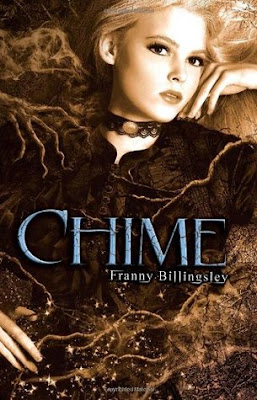
Chime by Franny Billingsley

chime by franny billingsley
After reading The Folk Keeper by Franny Billingsley a couple of weeks ago, I simply couldn't pick up any other book. I suppose it was the whole dreamy-ness of the book, the magical world that Ms. Billingsley managed to transport me to, that prevented me from coming back to real life. So, what to do? I picked up another book by this author for which she received several award nominations in 2011 - Chime. Yet another fantastic read, with all the magical elements I have come to expect from Franny Billingsley, and a romance even more gut-wrenching and heart warming than The Folk Keeper.

And what a journey Chime turned out to be! The book starts with the trial of Briony Larkin, the daughter of the town's clergyman. She has been accused of being a witch, which she has confessed to herself, and it is only a matter of time before the judge sentences her to death by hanging -- the usual way for a witch to die in the town of Swampsea. But before she can be hanged, she has to tell the story of her wickedness. It is her story that is the premise for the rest of the book. Briony is convinced that she is a witch. She has a gift, a gift that is common for a witch to have, the gift of the second sight that enables her to see and hear the Old Ones - beings that are not quite human, spirits that linger on this world and feed off of trees, water, forests, sometimes even the souls of human beings. Briony starts telling her story from the day Eldric (the town's new engineer's son) arrived in Swampsea; the day that changed things not only around the town, but also within Briony herself.

Briony's story is a ghastly one where she is as wicked as a witch can get. In her story she is a wicked witch who had caused many a calamity in her life, that resulted in people getting hurt really badly. For example, she managed to call a great wind that caused a terrible accident which has left her twin sister, Rose, with a mental disorder since the age of 7. Briony also remembers calling a great flood that had caused her stepmother to hurt her spine.

Tuesday, February 09, 2016

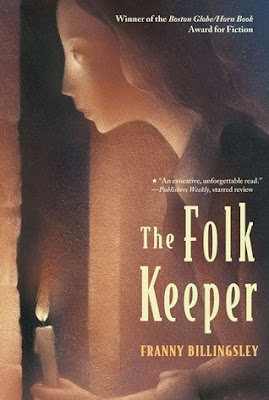
The Folk Keeper by Franny Billingsley

The Folk Keeper
Where should I even start? What is this story even about? A Goodreads user by the profile name "Millenia" wrote in her review of this little book (a little over 150 pages) that this story is a "perfect example of the Iceberg Theory". So true are her words!

The Folk Keeper by Franny Billingsley is a book for young adults. On the surface, it is a story about a girl, Corinna Stonewall, born at a time and in a place where being a girl is difficult, and especially so, if you are an orphan or a "Foundling". Regardless, she worked hard to find a place for herself where she belonged. Or at least she thought this was where she belonged. Until one day all of that changed for good.

At a glance, The Folk Keeper is a dark, but fairly straight forward, children's story, full of magical creatures, mystical powers, a strong female protagonist, and a sweet male lead. There is even a villain who would do anything to keep Corinna from her rightful position and inheritance. Doesn't sound very different from Cinderella, does it? But oh no, if it isn't anything but! I'm sure there are plenty of ways one can describe what this story is really about; however, I will tell you what I thought as I kept reading, not quite able to put it down until I read it all the way to the end.

In the beginning, we see Corinna as a feisty little thing who is ready to take revenge on anyone who manages to piss her off. She is quiet, but knows to hold a grudge. She also knows the ways of the World. And she is arrogant. There is a quote quite early on in the book, where Corinna is thinking to herself, "Everyone is afraid, only I am powerful". This pretty much shows her views of the World. She is very good at looking down on others, but to me, it seemed like a defense mechanism. She created a barrier between herself and the rest of the World because that was the only way she knew to protect herself. She never knew love, people only ever mistreated her. But as the story progressed, Corinna met people who showed her kindness; like Finian, and also the old dog Taffy, who surprisingly grew attached to her. While in the beginning she was wary of Finian as well as Taffy, pretending not to care, or even dislike them, eventually she starts to accept that even she can learn to care for others besides herself.